How We Determine the Safe Load Capacity on Our Trolleys

Posted by Kelly Hall on 23rd Nov 2026
At Handle-iT safety and reliability are at the heart of everything that we manufacture. Every trolley we design and supply is assessed to establish its safe load capacity ensuring that it is suitable for its intended application and can withstand the demands of every day use.
Determining the load capacity is not simply taking the rated capacity of the castors or wheels and multiplying by the amount of wheels. It involves consideration of the materials, load distribution, operating conditions and manufacture.
We mark every product supplied with a uniform distributed load (UDL), this is good practice and a safety standard. It also allows operators to see what limit each peice of equipment has. Even weight distribution allows equipment to function optimally.
Now, here comes the technical bit…
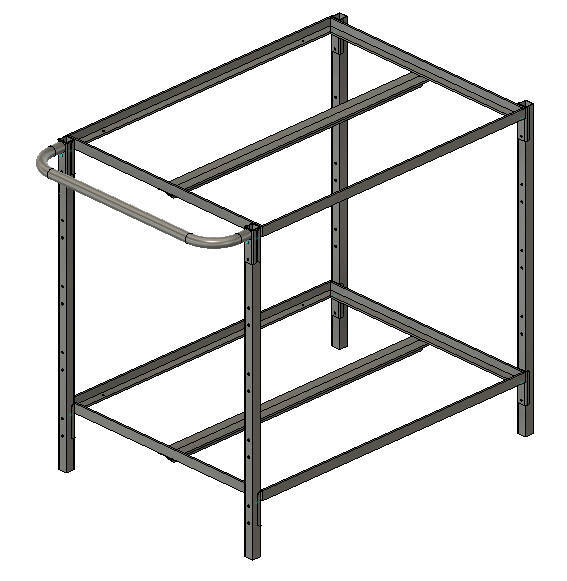
Determine the materials
Our load tests are run on the chassis of the product, meaning we remove all wheels, wood, and anything that doesn’t share the properties of the metal frame of the product. Different materials have different properties and different “Yield Point”. Yield Point (or yield strength) refers to the stress point above which a material will permanently deform and bend out of shape. Most materials will deform a small amount but then flex back into their original shape.
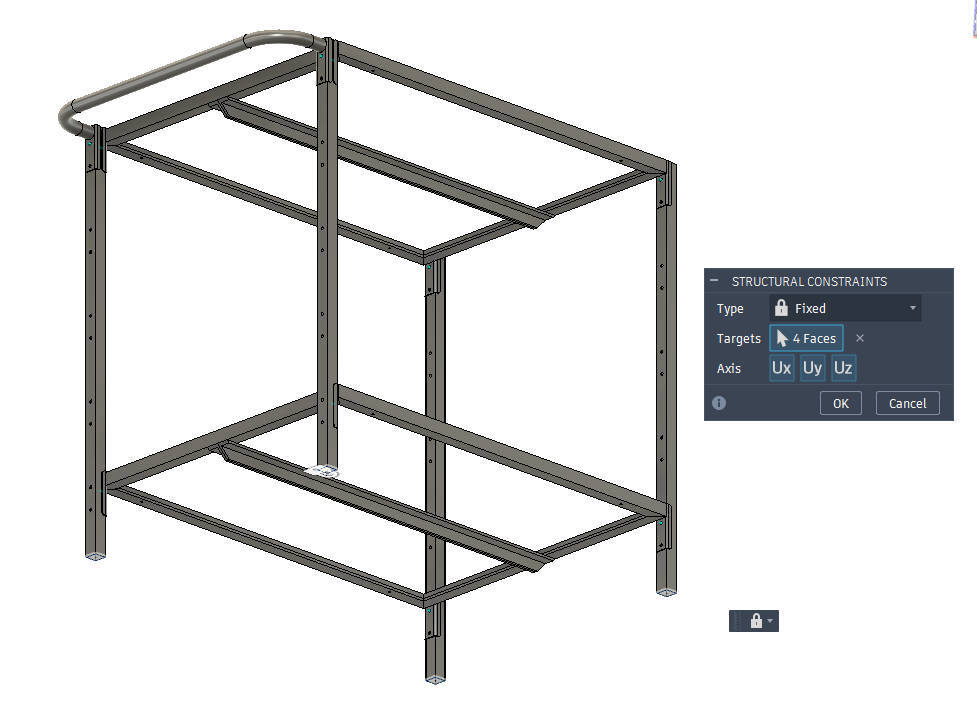
Constraints
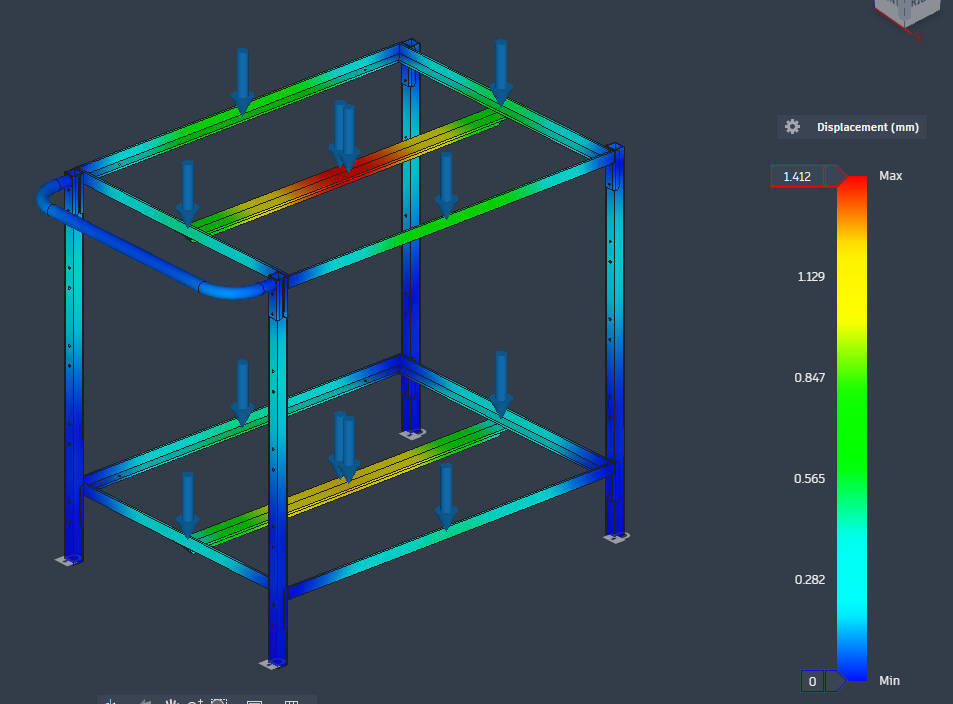
We must “constrain” the parts of the frame that either touch the ground, or are mounted to wheels. On a stillage, this is as simple as constraining the feet, but on a turntable trolley it would mean constraining the axles, and on a platform truck we would constrain the wheel plates. These constraints act as an anchor for any forces to push against.
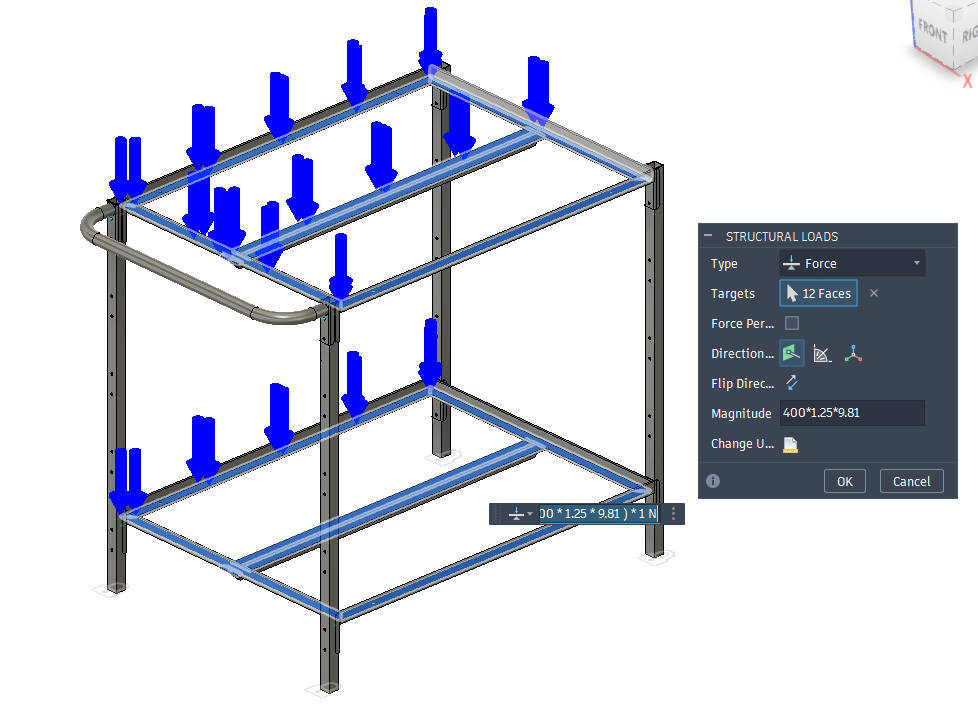
Forces
To test the chassis’ strength, we add one or multiple “Forces” to the frame. This is directional pressure measured in newtons (N), and in the majority of cases is simply the desired load capacity in kg, multiplied by gravity (9.81), and then with a Factor of Safety (FOS) added on top. The FOS tends to vary per trolley depending on the use-case, ranging from 20% (1.2 FOS) to 50%+. When testing a product such as a flatbed trolley, the forces would be positioned onto the platform, however when testing something such as a shelf trolley, the force would be distributed across all shelves evenly. For shelf trolleys, the same force is also applied on separate tests on each shelf in order to determine a maximum capacity for the trolley, and a separate maximum capacity per shelf. An example of this would be that a shelf trolley that has a 400kg capacity may only have a capacity per shelf of 200kg. neither capacity can be exceeded. These forces represent the UDL Capacity of the product, which you can read more about here
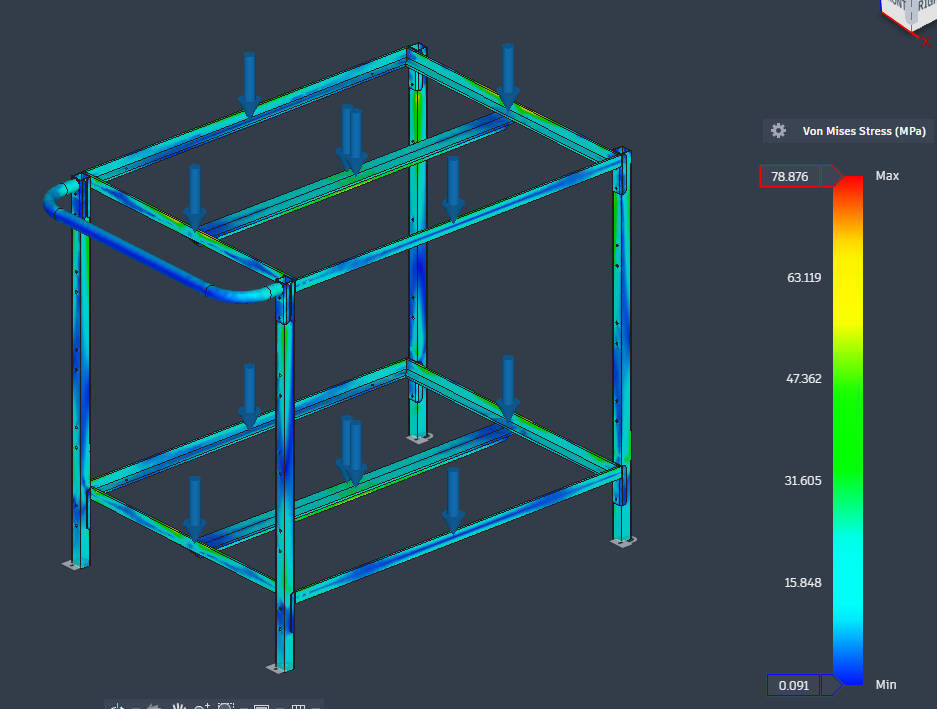
The Test
Running the test will simulate the pushing of the forces through the chassis into the constraints. The results will provide a large amount of detail, but the two most important are Deflection and the Von Misses maximum resultant stress (in Megapascals, MPa). Deflection will show how much and where the frame will bend from its original position and provides a value in millimetres (mm). This can be very important for products with moving parts, as this can cause mounting points to rub and wear quicker, or . The critical value is the MPa, as this relates to the Yield Point. Different grades of steel typically have fatigue limits from 215 to 280MPa, but as an extra margin of safety we typically set the threshold at 200MPa. Any time the maximum MPa exceeds this threshold, we identify the weak spot on the chassis and reinforce it by uprating the materials, or by adding extra braces and gussets before testing again.
In short, this is all determined by the type and grade of material used, the thickness or dimension of the frame and the strength of welded joints. ALL of our products are load tested before we specify a UDL and Load tests are performed as part of our bespoke fabrication service. We also have an independent load testing facility through Catena, a UK based specialist with over 45 years experience. Catena are our choice due to the ability to cater for our bespoke product requirements and the production of certification which is essential for compliance with many of our customers.
Wheels and Castors
Each wheel must be capable of supporting its share of the load and the weight of the trolley. ALL four wheeled trolleys should be rated over 3 wheels which means that if you have an issue with one then remaining three will not mean an automatic fail.
Ongoing Quality Control
We provide maintenance checklists for our equipment so that operators can regularly assess the condition of the trolley to ensure that the load of the trolley is still appropriate and accurate.
At Handle-iT we believe that the load capacity should be well considered and not simply to beat a competitor which ultimately puts the operator in grave danger. Whether you purchase from Handle-iT or another supplier consider the rating of the equipment to ensure that you are not putting your product, environment and staff at risk.